
A Kimono Night in St. Louis
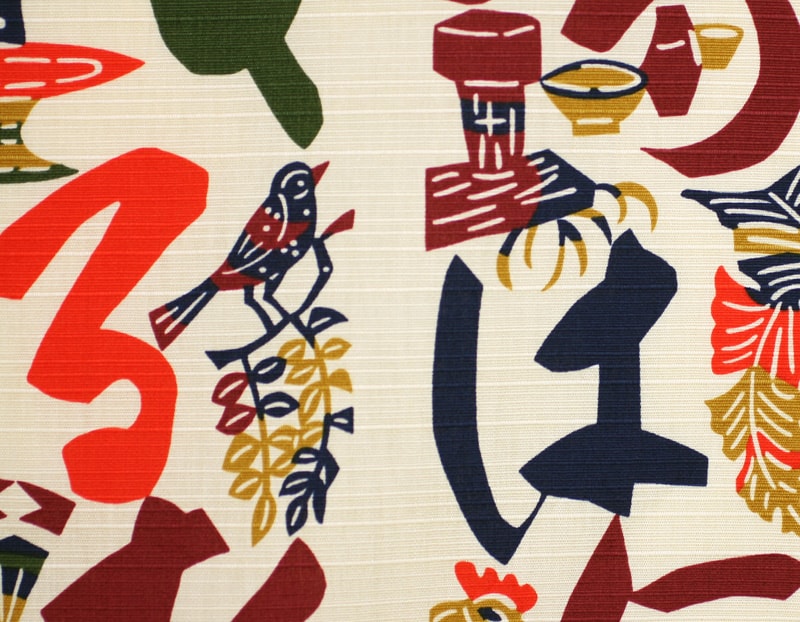
It’s a little late to write about this, but recently I was invited to a concert in St. Louis by **Hiroya Tsukamoto**, a guitarist and composer originally from Kyoto who studied at Berklee College of Music and is now based in the United States. He is known for his delicate, fluid arpeggios and for creating an orchestral soundscape with his unique use of the loop pedal. Since it was a Japanese artist, I decided to wear something meaningful and tied around my waist the *“Iroha” patterned obi*I had inherited from my grandmother. The flowing hiragana characters spreading out like a net felt just like musical rhythm… and I intuitively knew that this was the only obi that could harmonize with the music that would fill the stage.
Keisuke Serizawa and the World of Kataezome
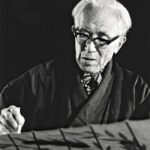
When it comes to the *Iroha*, I cannot help but think of **Keisuke Serizawa (1895–1984)**. Influenced by Okinawa’s *bingata** dyeing, he established his own style of stencil dyeing, known as *kataezome**, and in 1956 he was designated as a Living National Treasure (Holder of Important Intangible Cultural Property).
Serizawa’s work went far beyond kimono and obi; he brought beauty into everyday life through folding screens, book designs, glass paintings, calendars, and more. The spirit of his work embodied the principles of the *Mingei movement**, championed by Yanagi Sōetsu and others: “the beauty of the anonymous, found in everyday life.”
Yūzen and Kataezome
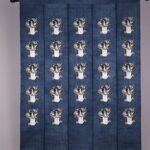
In my younger years, I graduated from a school in Kyoto where I studied **yūzen airbrush painting**. This year, I visited a hand-painted yūzen workshop and had the chance to experience it myself. Kyoto yūzen differs from Kaga yūzen in that it emphasizes the beauty of hand-drawn lines—subtle and vivid. In contrast, Serizawa’s kataezome uses stencils to carve out planes of color, producing rhythm and a balance of stillness and movement. Yūzen speaks in **lines**, while kataezome sings in **planes**. Though they are different forms of expression, both breathe stories into fabric through “the rhythm of color and blank space.” To wear art in this way is, I feel, one of the true luxuries unique to kimono.
The Iroha Poem and Buddhist Thought
And when we speak of the Iroha, we must also speak of **Keisuke Serizawa**—and when we speak of Serizawa, inevitably the **Iroha Poem** arises. The Iroha was originally composed as a learning tool for calligraphy, written in 47 characters without repetition. Yet this poem is deeply tied to Buddhist thought, and behind it lies the four verses of the **Nirvana Sutra**:
* **Shogyō mujō** (All things are impermanent)
* **Ze shōmetsu-hō** (All things arise and eventually perish)
* **Shōmetsu metsui** (Transcending birth and death to attain enlightenment)
* **Jakumetsu i raku** (True peace lies in liberation from delusion)
When we look at the Iroha lines in modern language, we find:
* I ro ha ni ho he to chi ri nu ru wo*
→ Flowers bloom beautifully, but eventually they scatter (impermanence).
* Wa ka yo ta re so tsu ne na ra mu*
→ No one can live forever (all things must perish).
* U wi no o ku ya ma ke fu ko e te*
→ Today I have crossed the mountain of suffering (transcendence).
* A sa ki yu me mi shi we hi mo se su*
→ Shallow dreams and intoxication are gone—I enter the realm of enlightenment (peace in liberation).
The Iroha poem is a quiet reminder to accept the impermanence of daily life, while urging us to cherish the importance of living fully in this very moment.
---
Music Intertwined with the Iroha Obi
That night, listening to music while wearing the Iroha-patterned obi was unforgettable. The waves of sound seemed to resonate with the characters woven into the fabric, flowing directly into my body.
“**Today I crossed the deep mountain of illusion**”—just as that line says, in the ever-changing flow of the music, I felt my daily worries dissolve. (I may be a monk, but I am still human—so I haven’t yet reached Nirvana, of course, haha.)
Best Night
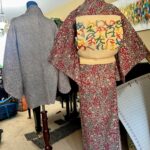
It was a night when I wore the obi passed down from my grandmother, immersed myself in Keisuke Serizawa’s world, and carried the Buddhist awareness of impermanence in my heart as I went to the concert. Hiroya Tsukamoto’s music—an intricate blend of folk, classical, South American rhythms, and Japanese sensibility—brought to mind landscapes I have traveled as well as those I have never seen, woven together with his own journeys. His piece about a **campfire** was especially vivid—I could almost smell the smoke—and it became my favorite of the evening.
It had been a long time since I last felt such a profound connection to Japanese spirit here in America, and it became an unforgettable experience for me. Wearing kimono reminds me that the meanings and histories embedded in them continue to resonate deeply, even with us who live in the modern age.
知蓮 Chiren
President, Japanese Institute of St. Louis
http://jiostl.org/
https://www.instagram.com/jiostl @JIOSTL
https://www.facebook.com/JIOSTL
#japaneseinstituteofstl #japaneseinstituteofstlouis #JIOSTL #jiostl #japaneseinstitute #kimonoclubstl #kimonoclub #STL #japaneseSTL #japanesestl #monk #shingon #meditation #doula #teastl #matchastl #matcha #teaceremony #workshop #hospice #japaneseworkshop #buddhism #buddhismstl #buddhist #kidsworkshop
#HiroyaTsukamoto #JapaneseGuitarist #AcousticGuitar #FingerstyleGuitar #MusicJourney #Soundscape #StLouisConcert #GuitarVirtuoso #LivingNationalTreasureOfMusic #IrohaObi #KimonoAndMusic #CulturalFusion #MusicAsMeditation #AcousticMagic #CrossingMountainsThroughMusic
(references)
* Hiroya Tsukamoto Official Website
[https://hiroyatsukamoto.com/about/](https://hiroyatsukamoto.com/about/)
* Acoustic Guitar Magazine(Hiroya Tsukamoto 特集記事)
[https://acousticguitar.com/how-guitar-virtuoso-hiroya-tsukamoto-arrived-at-his-unique-acoustic-style/](https://acousticguitar.com/how-guitar-virtuoso-hiroya-tsukamoto-arrived-at-his-unique-acoustic-style/)
* ATAC160(Hiroya Tsukamoto コンサート情報)
[https://www.atac160.org/news/hiroya-tsukamoto-acoustic-transcendence](https://www.atac160.org/news/hiroya-tsukamoto-acoustic-transcendence)
* 日本民藝館(芹沢銈介紹介ページ)
[https://mingeikan.or.jp](https://mingeikan.or.jp)
* IntoJapan WARAKU(芹沢銈介といろは歌)
[https://intojapanwaraku.com/rock/craft-rock/8539/](https://intojapanwaraku.com/rock/craft-rock/8539/)
* 国立工芸館(型染伊呂波文六曲屏風・所蔵作品)
[https://www.nmwa.go.jp/ncg/collection/serizawa-iroha](https://www.nmwa.go.jp/ncg/collection/serizawa-iroha)
* メトロポリタン美術館(Serizawa Keisuke 作品)
[https://www.metmuseum.org/art/collection/search#!?q=Serizawa%20Keisuke](https://www.metmuseum.org/art/collection/search#!?q=Serizawa%20Keisuke)