
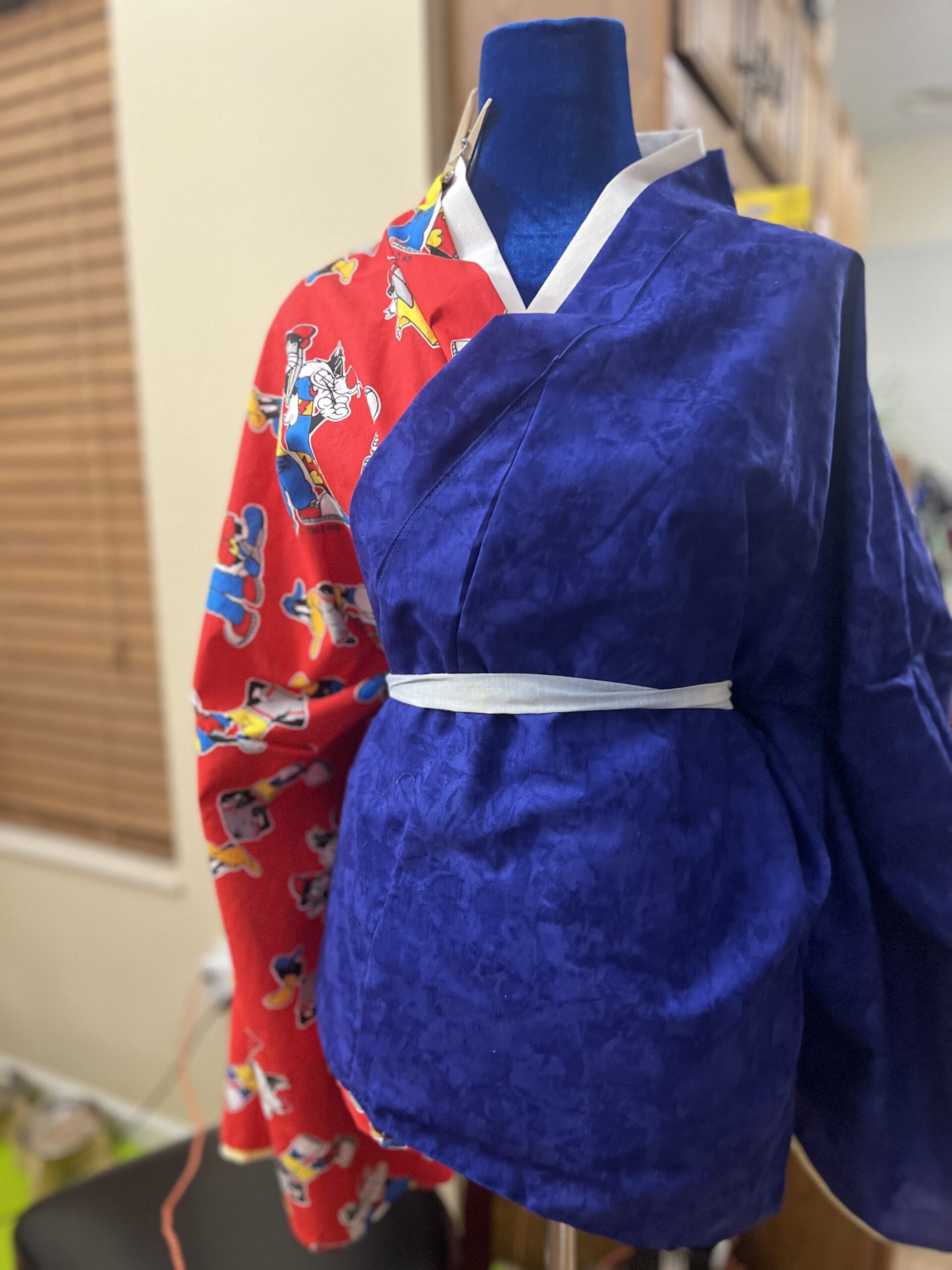
Thanks to your warm support, I was selected as a finalist for the Blue Mannequin Challenge—and ultimately received the top award. Right after I committed to the challenge, my 94 years old grandmother in Japan suddenly collapsed, and I had to return home on short notice. My production time was effectively cut in half. Even so, I kept stitching to the very last thread, determined not to let go of this amazing opportunity. When I received the news of the award, my heart was filled with nothing but gratitude.
Concept: Japanese Culture × SDGs ♻️

This work was conceived around my NPO’s core mission to promote Japanese culture (kimono) in the United States, layered with an SDGs perspective. I used repurposed materials—old curtains and cushion fabrics, textiles donated by a fellow NPO, City Sewing Room, and other upcycled sources. While expressing a sense of “Japan,” the piece also carries my affection for America, my home now; memories of the people I’ve met here; and hopes for the future/humanity—all stitched into a single garment. ✨
How a needle connects people
Since moving to the U.S., I’ve been blessed with countless wonderful encounters. At the same time, I’ve faced frightening experiences—having a gun pointed at my head in broad daylight, an attempted abduction, stalking, and discrimination—perhaps particular to St. Louis or related to being a minority. Yet I learned that shared loves—animals, art, crafts, and sewing—can connect people across differences in race, religion, and politics. Through rescue work for dogs, cats (and even pigs), friendships at the dog park, and learning together at Meetup, I have often felt the joy of sharing passions and growth.
I also serve as a hospice and death doula for people at the end of life. Knitting and sewing often become gentle tools that open conversation—and sometimes even help rekindle memories. In this challenge as well, “sewing” became a bridge between people. I am deeply grateful to everyone at City Sewing Room for welcoming me so warmly and helping me reach the finish line.
Why kimono, and why now?
At our small nonprofit, the Japanese Institute of St. Louis, we introduce Japanese culture through crafts, kimono, tea, and meditation. In recent years, matcha has surged worldwide, becoming expensive and hard to obtain even in Japan, while pure silk kimono can be re-sell for nothing. It pains me to see one aspect of culture prized while another fades.
Kimono is often called the ultimate sustainable fashion: cut straight from the bolt with minimal waste, and with a few alterations it can be worn across generations and body types. I myself treasure several kimono passed down from my great-grandmother. To convey this sustainable aspect while making it practical in America, I cropped the garment for ease of wear and designed it to be adjustable from S to 5XL.
Obi: function with styles
Respecting tradition while adding an update, the obi can be styled in two ways: a large ribbon silhouette inspired by the “Daki/Oiran” look (known from Anime Demon Slayer) and a quieter, smaller ribbon. Because the piece was displayed for about a month, I chose hook-and-loop tape for durability and convenience at the end, while shaping was originally set by hand-tying.
Symbols embedded in the design
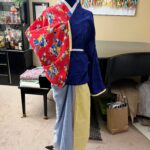
The red of the bodice represents America; I chose a Bugs Bunny print because the first animal I rescued—and later welcomed into my family—was a grey bunny, and it is also an homage to my rescue mentor, “Bunny Mom.”
The blue, or “Samurai Blue,” represents Japan—its pride and spirit.
The yellow honeycomb pattern stands for environmental stewardship—issues that cross borders—and our responsibility as members of this planet.
For the skirt, I deliberately left rips, holes, and frays in the denim to visualize the anger, sorrow, and unstability of the working class. In contrast, the clean yellow half embodies a firm will toward environmental conservation.
Beneath it, a pink chiffon frill hints at inner femininity and the still-present societal burdens on women, evoking the “glass ceiling.”
I rendered the whole piece as patchwork to express Japan’s idea of “imperfect beauty,” like a kintsugi. Even if things are broken or become disparate, re-stitching can bring them back—stronger and more beautiful. That type of prayer is sewn into this work.
Fabrics, obi, and accessories
For the obi, I used donated cushion-cover fabric. I was instantly drawn to its golden, scale-like motif—an ocean lover’s first sight love. The back is made from old curtains, and once sewn, it looks like a big snake—an image of being constricted by society. At the same time, the “butterfly ribbon” style envisions a future of shedding that old skin and flying freely like a butterfly.
For the obijime/obiage accent, I incorporated patterns from “PowWow,” a Native American cultural tradition rooted in Missouri. Depending on how and where it’s tied, the piece can serve as an obiage, belt, scarf, or even a necktie—a gender-free design.
Accessories: a reversible book cover that holds history
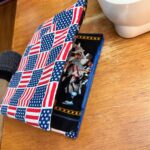
I upcycled a discarded Blu-ray case into a book cover modeled after the U.S. Declaration of Independence. The reversible construction references the history of the U.S. flag raised upon Native land and hints at ongoing land return claims.
People often say "NO one truly wins in war" and that “JUSTICE has two sides"; the reversible nature is meant to embody that duality.
Camouflage crane for peace
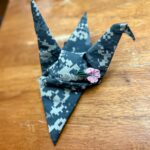
In Japan, the crane symbolizes peace. I sewed a crane from donated military-pattern fabric, with a prayer that those in the military may return home safely. The cherry blossom—usually five-petaled—was crafted as a tsumami-zaiku flower with seven petals: “lucky seven,” blessing and happiness. It gently lands on American soil.
In closing: a prayer in every stitch
Kimono is meant to be handed down within families—sometimes unstitched and restitched—carrying history and love while changing shape to fit the next wearer. In an era of division, this design embodies my wish to find something we love and to lean toward mutual understanding, even between those who seem different.
For me, the bridges between people are sewing, animals, art and craft, Japanese culture, and volunteer work. Even on days when I feel tired or irritated, each stitch reminds me of bonds with others. I am sincerely grateful to City Sewing Room and to everyone who supported me. May you, too, find connection with others through the things you love—just like this garment. ✨
Chiren
President, Japanese Institute of St. Louis
https://www.instagram.com/jiostl
@JIOSTL
https://www.facebook.com/JIOSTL
https://japanesestl.org