
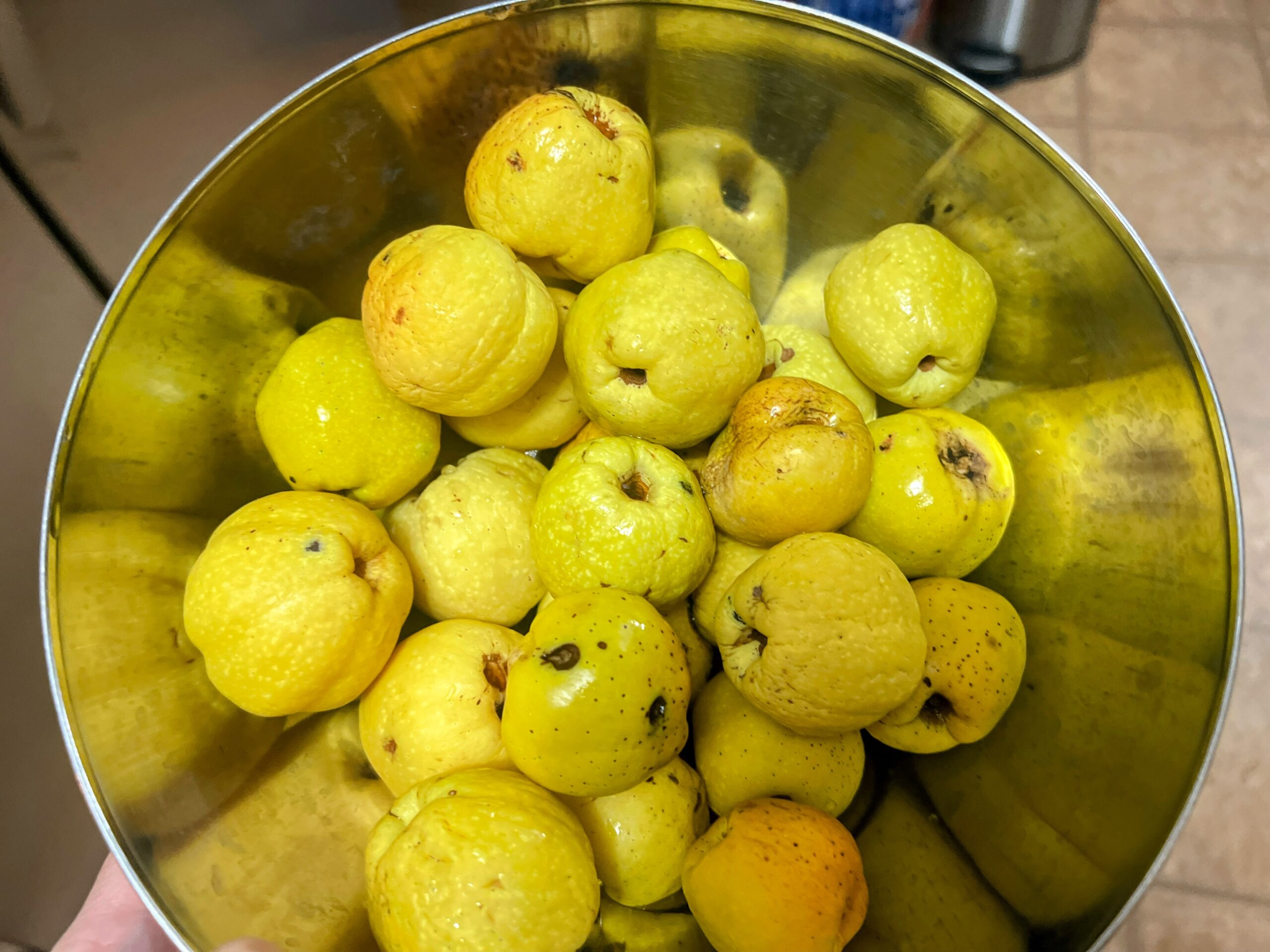
🍐 What Is Karin?
Have you ever heard of the fruit called “karin” in Japanese?
Karin is a wonderfully fragrant fruit that ripens from late autumn into winter.
In my grandmother’s generation, karin syrup and honey-preserved karin were well-known as a homemade winter remedy that worked very well for sore throats.
As I wrote in my previous post about ume plums, karin is another mysterious fruit:
even though it is extremely hard and cannot be eaten raw, its aroma and flavor become beautifully pronounced when processed into jam, marmalade, honey preserves, or fruit liqueur.
Karin, like ume, belongs to the rose family.
Other fruits that look similar—such as loquat and apricot—as well as fruits that don’t look similar at all—apple, pear, peach, plum, cherry, strawberry, and raspberry—are all part of the rose family.
🍐 Encountering “Western Quince” in America
One day, I happened to come across a listing on Facebook Marketplace offering “fruit that looks like karin” for free pickup.
When I translated and checked carefully, it turned out to be a Western variety of quince, slightly different from Japanese karin.
Although Japanese karin (Pseudocydonia sinensis) is botanically different, both can be cooked into jams or tarts, and are similarly enjoyed after processing.
I usually do not eat jams other than blueberry or raspberry, but the ume jam I made recently turned out unbelievably delicious.
This made me very curious about what jam made from Western quince would taste like.
So I quickly contacted the seller, and she kindly offered to share some with me.
She turned out to be a very charming and friendly person, and we ended up chatting for a long time.
According to her, many people from all over the world had contacted her about the fruit.
When she asked what I planned to make, I said either a syrup for sore throats (with alcohol, haha) or jam.
She then told me that in Middle Eastern cultures as well, quince is preserved in honey and used medicinally—and she had recently shared some with someone from the Middle East too.
It is fascinating that similar uses of quince exist not only in Asia but also in many places around the world.
🍯 The Quince Jam

Now, about the quince jam itself:
it turned out to be delicious, similar to marmalade.
The fragrance remained gently present, and the firmness of the peel added a lovely accent, giving it a more refined, marmalade-like finish than ordinary jam.
I thought it might also be delicious not only on toast but also in tea.
So I added some to strawberry tea, and the slight acidity blended beautifully—it was wonderful.
🍐 Basic Quince Jam Recipe
Ingredients
* Quince … about 600–800 g
* Sugar … 40–60% of the weight of the quince
* Lemon juice … 1–2 tablespoons (adjust to taste)
Preparation
1. Wash the quince thoroughly. Without peeling it, soak it in boiling water for 30 minutes .
2. Remove the seeds and core.
*(The area around the seeds contains natural pectin, which helps the jam gel.)*
3. Thinly slice the quince or cut it into small cubes.
4. Place the cut quince into a bowl of salt water to prevent discoloration.
How to Make Quince Jam
1. Remove the quince from the salt water and measure the weight of the fruit.
2. Add sugar equal to 40–60% of the fruit's weight.
3. Add lemon juice.
4. Simmer over low to medium heat for 20–40 minutes .
* Skim off any foam that rises.
* Stir occasionally to prevent burning.
5. When the mixture thickens and turns a clear amber color, the jam is ready.
Storage
* While still hot, pour the jam into sterilized jars and seal.
* Let the jars cool upside down.
* Store in a cool, dark place for 2–3 months .
* After opening, refrigerate and use within 1–2 weeks .
🍶 Making Quince Liqueur
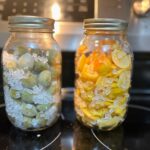
I decided to use the rum I already had at home to make quince liqueur.
In Japan, homemade fruit liqueurs are usually made with white liquor, but this time I used the remaining rock sugar from my previous ume liqueur and the rum I had on hand.
Since I already had some frozen ume leftover, I decided to throw them in as well.
I read that using rum adds depth and mellowness to the aroma of the quince, so I’m very excited to see how it will taste in six months.
It’s just a shame it won’t be ready in time for Christmas!
🍐How to Make Homemade Quince Liqueur (Karin-shu)
Ingredients
* Quince … 1 kg
* Rock sugar … 500–800 g (adjust sweetness to your preference)
* Your choice of liquor (around 35% alcohol ) … 1.8 L
* A sterilized glass jar … 4 L capacity
Preparation
1. Wash the quince thoroughly and pat completely dry.
2. Slice the quince into 1 cm thin rounds with the peel on.
3. Remove any bruised or damaged parts.
How to Assemble
1. In the jar, layer the ingredients in the order of
quince → rock sugar → quince , repeating until full.
2. Slowly pour in the liquor, making sure all the quince is fully submerged.
3. Seal the jar tightly and store it in a cool, dark place.
Aging
* 3–6 months: The aroma begins to develop and the liqueur becomes drinkable.
* 6 months–1 year: The flavor becomes round, mellow, and reaches its best quality.
🌱 Planting Quince Seeds
When making the quince liqueur, I had to remove many damaged fruit pieces, and a lot of seeds came out.
So I decided to save the seeds and try planting them in the spring.
I washed the seeds carefully and dried them for two to three days.
After researching, I learned:
* The seeds “like the cold.”
* If you place them in the refrigerator for 4 to 6 weeks before planting, they germinate more easily.
I plan to plant them in the soil in March, and for now, the seeds are resting quietly in the refrigerator.
In the past, I have planted many things in my yard, but they often get dug up by squirrels and rabbits, and even when something finally starts growing, my husband sometimes mows it over with the lawnmower.
So I never know what has survived (lol).
Still, maybe in seven years, a quince tree will grow!
With that small dream in mind, I am looking forward to spring when I can plant the seeds.
It was a lovely weekend project and a perfect winter handcraft.
📚 Reference Links
1. Wikipedia – Karin (Rosaceae)
[https://ja.wikipedia.org/wiki/%E3%82%AB%E3%83%AA%E3%83%B3_(%E3%83%90%E3%83%A9%E7%A7%91)](https://ja.wikipedia.org/wiki/%E3%82%AB%E3%83%AA%E3%83%B3_%28%E3%83%90%E3%83%A9%E7%A7%91%29)
2. Specialty Produce – Wild Japanese Quince
[https://specialtyproduce.com/produce/Wild_Japanese_Quince_22102.php](https://specialtyproduce.com/produce/Wild_Japanese_Quince_22102.php)
3. Mynavi Agriculture – What Is Karin? Characteristics and Ways to Eat
[https://agri.mynavi.jp/2020_05_10_118320/](https://agri.mynavi.jp/2020_05_10_118320/)
4. Kumamoto University Medicinal Plant Database – Karin
[https://www.pharm.kumamoto-u.ac.jp/yakusodb/detail/003356.php](https://www.pharm.kumamoto-u.ac.jp/yakusodb/detail/003356.php)
5. “The Japanese Quince, a forgotten fruit?”
[https://despitethesnow.wordpress.com/2023/12/02/the-japanese-quince-a-forgotten-fruit/](https://despitethesnow.wordpress.com/2023/12/02/the-japanese-quince-a-forgotten-fruit/)