

2026.02.05
In my previous blog post, I introduced an innovative idea for bringing home “memories of Japan.” Today, as a continuation of that topic, I would like to write about another issue that every traveler has struggled with at least once: storage space.
For those who travel by airplane, traveling often feels like a constant battle between memories and luggage weight. I am no exception. Every time I travel, I am extremely careful when packing to avoid exceeding the weight limit (and paying extra fees—laughs).
For that reason, my second suitcase is always a fabric suitcase, and my third bag is a foldable duffel bag. I also always carry a portable luggage scale that allows me to hook my bags and check their weight in advance. The day before my flight, I carefully repack everything to make sure I can board within the allowed weight limit.
The souvenir problem

When we travel, it is only natural to want to buy souvenirs.
Two years ago, I heard that the Nintendo Museum had opened in Kyoto, so I visited with my aunt. Because the museum offers exhibits and interactive experiences—including discontinued products and games that can only be played there—I entered thinking, Which game should I try first?
At that moment, I witnessed a scene unfolding in front of me: many Asian travelers rushed straight to the museum shop, “BONUS STAGE,” before even touring the exhibits.
Curious, I asked a staff member why. I was told that the shop carries exclusive items that can only be purchased there. My entry time was 10:00 a.m., but by then, cookies and some of the large plush toys were already sold out.
“BONUS STAGE” is the official merchandise store themed around Nintendo’s game worlds and characters. It offers a wide range of original products—mugs, T-shirts, pin badges, and more—featuring Nintendo consoles throughout history: the Family Computer, NES, Disk System, Game Boy, Super Famicom, Super NES, Virtual Boy, Nintendo 64, Game Boy Advance, GameCube, Nintendo DS, Wii, Nintendo 3DS, Wii U, and Nintendo Switch.
Even if you were not selected in the museum ticket lottery, you can still visit Kyoto Takashimaya to take photos and purchase some merchandise. However, certain limited items—such as exclusive products, keychains, and large controller-shaped cushions—are only available at the Nintendo Museum.
That is why so many people head straight to the shop upon entry. When I asked a staff member how people manage to bring such large items home, they replied that some travelers purchase an extra airplane seat just for the item.
In fact, I did see a family on my flight back to the U.S. carrying one of those oversized cushions.
 Speaking of giant plush toys, Japan’s game centers and UFO catchers immediately come to mind.Those large plush toys that you might win for “500 yen per try” are thrilling in the moment—but once you actually have one, they take up far more space than expected. They are cumbersome on crowded trains and buses, and they dominate suitcase space as well. Because of this, I’ve recently found myself just watching rather than playing.
Giant Plush Toys and Game Centers
Recently, I heard that some game centers offer a free service that compresses plush toys into vacuum storage bags. When I looked it up, sure enough, a huge Yoshi plush had been flattened completely.
With a service like that, I would happily try the UFO catcher again and aim for a large plush toy.
I hope that compression services like this will become available not only at game centers, but also—perhaps for a fee—at tourist hotels or near station coin lockers.
In Kyoto, it is common to see families struggling in front of coin lockers, desperately trying to fit everyone’s belongings into a limited space. It is natural for luggage to increase during a trip, and it makes sense to want to bring home more items along with your memories.


Clothing compressor demonstration experiment
To address this suitcase problem, Narita Airport has begun a trial experiment by installing clothing compression machines.
As I mentioned in my previous blog, goshuin and osamefuda received at temples and shrines are important items that represent a spiritual connection with the principal deity. These are not items that can simply be compressed like plush toys or stamped casually onto a tote bag.
Even so, air travel inevitably involves a constant struggle with available suitcase space. In recent years, Japanese airports have seen a growing number of abandoned suitcases left behind by tourists.
As a practical solution, Narita International Airport Corporation (NAA) partnered with an apparel-related startup called SJOY to install clothing compression machines and offer them free of charge to travelers. Toward the end of a trip, some travelers buy too many souvenirs at the airport, find that everything no longer fits, purchase a new larger suitcase, and leave the old one behind.
The number of abandoned suitcases has increased dramatically—about 8.5 times in just four years:
- 2020: 124 cases
- 2021: 338 cases
- 2022: 552 cases
- 2023: 811 cases
- 2024: 1,034 cases

Some abandoned suitcases are locked, making it impossible to inspect their contents. This creates an increasing burden on airports, which must allocate staff for safety checks and storage before turning items over to the police.
To address this, Narita Airport installed a device called “Pocket Tips,” which can compress clothing to as little as one-seventh of its original size. In just one minute, items can be compressed down to palm size. While the weight does not change, this technology has great potential to reduce suitcase abandonment caused by lack of space.
Incidentally, Kansai International Airport offers a free suitcase collection service at the Temporary Baggage Storage Counter on the 4th floor of Terminal 1’s international departure area.
Reusing Abandoned Suitcases
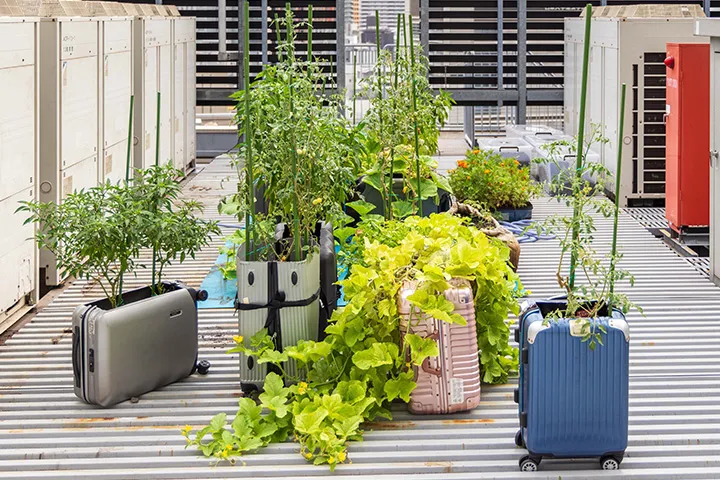
Abandoned suitcases are not limited to airports. In Japan, where the weak yen encourages heavy shopping, travelers often buy larger suitcases and leave their old ones behind. Others abandon suitcases when wheels or zippers break during a trip, leaving them in hotel rooms or hallways.
At Hotel Niwa Tokyo, abandoned suitcases were once discarded at the hotel’s own expense as bulky waste. However, the hotel began transforming them into planters, growing pesticide-free vegetables and herbs on the rooftop, which are then served in the hotel restaurant.
This rooftop garden began when staff wondered whether fallen leaves from the courtyard could be turned into compost. Leaves became leaf mold, kitchen scraps became compost, and eggshells from breakfast service were turned into lime. Soil was packed into burlap sacks obtained from coffee suppliers, but the sacks failed to retain moisture. That is when the idea of using abandoned suitcases as planters emerged.
In the United States, old suitcases are sometimes reused as beds for rescue dogs and cats. While this may be more challenging in Japan’s limited living spaces, the idea of giving broken items a second life rather than discarding them is truly wonderful.
It may be a little difficult in Japan's limited living environment, but it's nice to be able to repurpose broken suitcases into something else rather than just throwing them away.
"Suitcases are not easily thrown away."
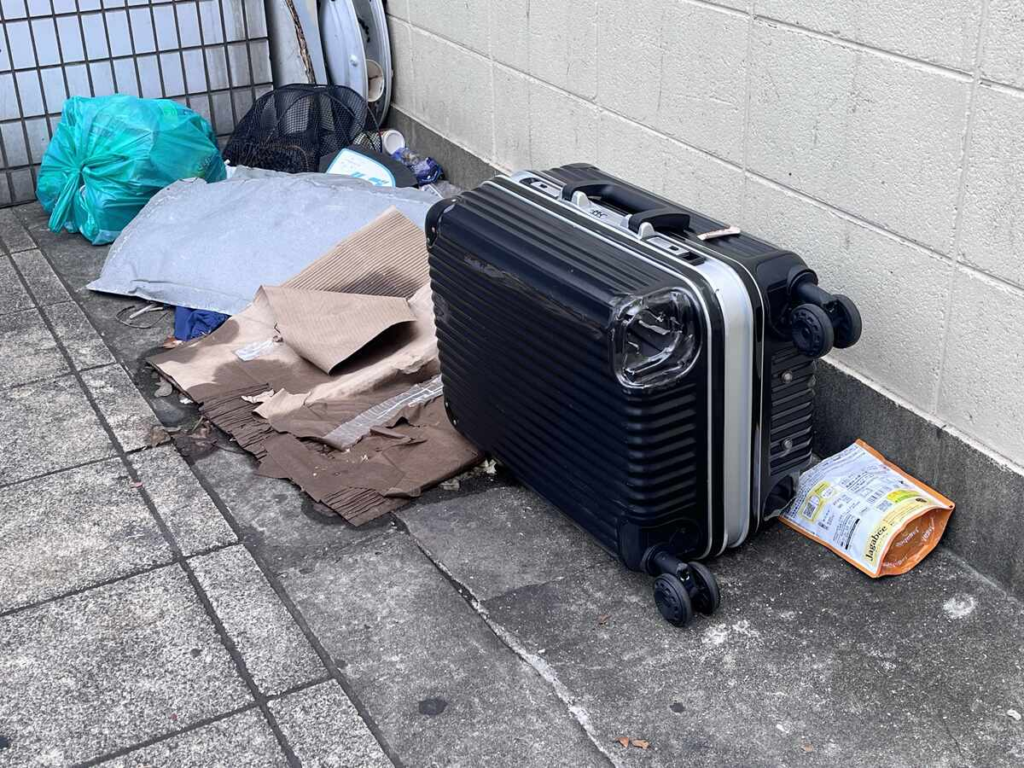
Why does suitcase abandonment occur so frequently in Japan?
One major reason is Japan’s strict waste separation and recycling rules. Even in public places like train stations, trash is sorted into multiple categories: newspapers and magazines, bottles and cans, PET bottles, plastic waste, and paper/wood products.

In many municipalities, large items that do not fit into trash bags require advance notice to city hall and a paid collection service. Disposal days are strictly scheduled, trash bags are not free, and rules vary by region.
Waste separation categories:
- Fewer systems: about 5–8 categories
- Standard: around 10 categories
- Detailed systems: 15–20 categories
- Very strict municipalities: over 20–30 categories
Under these conditions, disposing of a large item like a suitcase during a short trip is extremely difficult. As a result, some travelers may choose to abandon suitcases rather than navigate the system.
Japan’s Most Strict Waste-Sorting Town

One of the strictest waste-sorting systems in Japan can be found in Kamikatsu Town, Tokushima Prefecture, where trash is sorted into about 60 categories. The town is known as a Zero-Waste Town.
Kamikatsu is a small mountain town with a population of about 1,400. It is famous for specialty products such as Awa Bancha tea, the rare citrus fruit Yuko, and Amago trout. A senior from my university is from Kamikatsu, and I once had the pleasure of tasting Awa Bancha and Amago there—both were exceptional.
Although the town officially lists 34 categories, actual sorting on site reaches about 60. Residents bring trash to a waste center at their convenience, sort it themselves, and there are no household garbage trucks. As a result, in 2020 the town reduced waste to 294 tons and achieved a recycling rate of 81%, generating both cost savings and revenue from recyclable materials.
Sorting Waste Pays Off
Kamikatsu’s success lies in its philosophy: “Mixed together, it’s garbage. Sorted, it’s a resource.”
The town introduced a reward system called “Chiritsumo Point Service,” where residents earn points for recycling, refusing plastic bags, or using reusable containers. Points can be exchanged for goods, and monthly lotteries add an element of fun.
Incinerating waste costs about 57 yen per kilogram, while selling recycled paper earns about 13 yen per kilogram. The town returns these savings to residents in visible ways, reinforcing motivation.
(“Chiritsumo” comes from the phrase “Chiri mo tsumoreba yama to naru”—small efforts add up.)


A Circular Society That Begins with Leaves and Waste Sorting

As mentioned at the beginning, Kamikatsu is the smallest town in Shikoku, with a large elderly population. In 1950, it had a population of over 6,000 people, but with the decline of forestry, depopulation progressed and the town's economy hit rock bottom. Today, Kamikatsu has attracted attention from around the country and the world for its strict garbage sorting and zero-waste initiatives. However, Kamikatsu is also a major producer of garnishes, essential to Japanese cuisine, and is known for its unique "leaf business" model.
At first, there was strong opposition, with people saying, "There's no way you can make money from fallen leaves (garnishes)," but they thoroughly studied the needs of chefs and continued to teach farmers how to create products that emphasize size, color, and seasonality. Their success was described with symbolic phrases such as "Countryside grandma earns 10 million yen a year collecting leaves," and was featured in overseas media such as TIME and Forbes, and was made into a film in 2012 called "Life, Colorful."
Since 1987, the town has been shipping maple leaves, nandina leaves, camellia leaves, and other leaves and flowers used to garnish dishes under the brand name "Irodori." At its peak, the town generated annual sales of approximately 260 million yen, growing into a key industry for the town. Surprisingly, the majority of producers are elderly women over the age of 70, with approximately 145 households still engaged in farming. Some women have earned such a high income from the leaves that they have been able to build homes for their children who are returning to their hometowns. In Kamikatsu, the smallest town in Shikoku with a population of approximately 1,400, this case overturns the common belief that "elderly people = those who need support."
I think what this leaf business and the Zero Waste initiative have in common is "carefully nurturing people and systems." Kamikatsu town's trash is carefully separated and recycled as resources. It's about making the most of things, not throwing them away.
Protecting the environment is not something to be endured or obligated, but something that is naturally integrated into daily life. Kamikatsu Town has been striving to create a recycling-oriented society built on the accumulation of such efforts.
Sorting trash, shipping leaves, and reforestation may all seem like small individual initiatives. However, by linking these together and nurturing them over a long period of time, Kamikatsu has demonstrated one answer: a "small but sustainable town." With values that differ from mass production and efficiency, the town believes in the power of human hands and nature, and has established recycling as a part of daily life. The town's greatest strength lies in the fact that it practices this on a town-wide basis.

I strongly believe in the importance of recycling and remaking. In the U.S., donation culture helps ensure that items are rarely wasted.
I am currently a foster caregiver and adoption committee member for animal rescue in St. Louis City. What I see every day is how items that seem unusable can be reborn for dogs and cats.
Old bed sheets with holes, toilet paper rolls, egg cartons, tissue paper from Christmas wrapping, scrap fabric, and baby socks can all be repurposed into enrichment and comfort items for animals.
If you have items at home that could be reused, we would greatly appreciate your donation.
Small acts of remaking can become a powerful force in saving lives.
The Japanese Institute of St. Louis is also looking for volunteers to help create crafts and remake items using recycled materials. If you are interested, please contact us.
Reference Links
https://zwtk.jp/en/
https://www.irodori.co.jp
https://www.kamikatsu.jp
https://www.japan.go.jp/tomodachi/2013/spring2013/kamikatsu.html
https://www.nhk.or.jp/archives/chronicle/detail/?crnid=A201203180010001302100
https://eiga.com/movie/56888/
https://www.awanavi.jp/archives/topics/18906#:~:text=%E5%BE%B3%E5%B3%B6%E7%9C%8C%E5%8B%9D%E6%B5%A6%E9%83%A1%E4%B8%8A%E5%8B%9D,%E3%82%82%E5%A4%89%E3%82%8F%E3%82%8B%E3%81%A8%E3%81%84%E3%81%86%E3%81%AE%E3%81%A7%E3%81%99%E3%80%82
https://www.yomiuri.co.jp/national/20260111-OYT1T50100
https://www.ytv.co.jp/miyaneya/article/page_6cbwhmtf2330yhsw.html#:~:text=%E5%A2%97%E5%8A%A0%E3%81%99%E3%82%8B%E6%94%BE%E7%BD%AE%E3%82%B9%E3%83%BC%E3%83%84%E3%82%B1%E3%83%BC%E3%82%B9,%E3%81%AE%E6%B4%BB%E7%94%A8%E6%96 %B9%E6%B3%95%E3%81%A8%E3%81%AF&text=%E3%81%9D%E3%82%93%E3%81%AA%E4%B8%AD%E3%80%81%E6%A7%98%E3%80%85%E3%81%AA %E5%AF%BE%E7%AD%96,%E7%84%A1%E6%96%99%E5%9B%9E%E5%8F%8E%E3%81%97%E3%81%A6%E3%81%84%E3%81%BE%E3%81%99%E3%80%82
https://www.nippon.com/ja/guide-to-japan/gu900259/
https://o-temoto.com/akiko-kobayashi/kamikatsu2/
https://o-temoto.com/akiko-kobayashi/kamikatsu1/
https://zwtk.jp/separate/
https://zwtk.jp/zwcenter/
https://www.kamikatsu.jp/zerowaste/sengen.html
https://www.kamikatsu.jp/docs/2017040700010/file_contents/R2betsugideobook.pdf
https://news.tv-asahi.co.jp/news_society/articles/000285571.html
https://www.env.go.jp/policy/kihon_keikaku/goodlifeaward/report201801-zerowaste.html
https://www.travelvision.jp/news/detail/news-82674#:~:text=%E9%96%A2%E8%A5%BF%E3%82%A8%E3%82%A2%E3%83%9D%E3%83%BC%E3%83%88%E3%81%AF%E3%80%81%E9%96%A2%E8%A5%BF%E5%9B%BD%E9%9A%9B,%E5%9B%B3%E3%81%A3%E3%81%A6%E3%81%84%E3%81%8F%E3%81%A8%E3%81%97%E3%81%A6%E3%81%84%E3%82%8B%E3%80%82
https://www.hotelniwa.jp/about/econiwa/
https://www.sankei.com/article/20250625-PAYAZCLBZJOUDEZKK4ULYARH6Y/
https://indojapanpulse.com/2019/06/japanese-art-of-garbage-sorting-and-disposal
https://o-temoto.com/akiko-kobayashi/kamikatsu2/
https://www.carlabethany.com/make-vintage-suitcase-dog-bed/
https://game.watch.impress.co.jp/docs/preview/1625869.html
https://www.watch.impress.co.jp/docs/news/1466405.html
https://www.hotel-niwa-tokyo.jp/
https://www.asahi.com/